www.businessads.info

Now you have a good oportunity to take possession of back link for your life time.if you like to get back link to your website.you can join with us. Do not waste time.you have the rarely chance from our web site .<<<<< order now >>>>

www.businessads.info

Now you have a good oportunity to take possession of back link for your life time.if you like to get back link to your website.you can join with us. Do not waste time.you have the rarely chance from our web site.<<<<< order now >>>>

www.businessads.info

Now you have a good oportunity to take possession of back link for your life time.if you like to get back link to your website.you can join with us. Do not waste time.you have the rarely chance from our web site .<<<<< order now >>>>

www.businessads.info

Now you have a good oportunity to take possession of back link for your life time.if you like to get back link to your website.you can join with us. Do not waste time.you have the rarely chance from our web site.<<<<< order now >>>>

www.businessads.info

Now you have a good oportunity to take possession of back link for your life time.if you like to get back link to your website.you can join with us. Do not waste time.you have the rarely chance from our web site .<<<<< order now >>>>

Sunday, 30 September 2012

iPhone 5: It's Morning in Technology


The signal is strong and lighting up all five bars: We live in the post-Steve-Jobs-era. The flubbed launch of the iPhone 5, and its ensuing problems, is going to create new opportunities for technologists and entrepreneurs across the world in lucrative areas that Apple had bottled up for the five years.

Even though I'm an ex-Apple employee and Objective-C programmer, typing this blog post on a MacBook Air, with my iPhone and iPad both within easy reach, I am happy.

There's a tremendous amount of speculation about where Apple is headed but it's clear to me that the age of Apple's dominance on our collective imaginations is on the wane. Every era has an expiration date and Apple's is about to come due. (If that upsets you, don't panic, eternalism might help.)

Looking back on the last 25 years in technology it's pretty clear to me that there is a pattern of alternating chaotic periods with fierce competition and stable periods of domination by one major player. During the chaotic periods competing ways of thinking about a problem and the entrepreneurs that champion these business models fight it out for mainstream success. The contest is winner-take-all and the player that succeeds creates an ecosystem upon which its rivals must live in order to survive to fight another day. The dominant player gets to play the piper and the losers must dance to its tune, or iTunes.

During my life I can remember four periods where a single player dominated the tech world so completely that I had to change my job description, programming language, and thought patterns to prosper:

IBM and the PC Compatible in '80s
Microsoft and Windows in '90s
Google and search in early '00s
Apple and the iPhone in the late '00s and early '10s
IBM, which doesn't even make personal computers anymore, once so completely dominated the technology world that every business plan was a plan to fit into IBMs scheme of things or to break it. Apple grew to maturity out of a rebellion to IBM's way of thinking and has been a rebel for 30 of its 36 years.
I had great fun being an Apple fanboy before Apple become dominant. When I walked into a meeting or coffee shop and yanked out my black MacBook laptop (a collector's item now) its radical style started conversations and garnered looks of envy or distain. Now in every meeting I attend and every coffee shop I frequent I have this uncomfortable feeling that I'm in a Apple commercial. Everyone has the same shiny MacBook Air with glowing Apple logo on the lid.

While the iPhone 5 release is a devastating flub for Apple it's a fantastic opportunity for the rest of us. The interesting thing to note is that nothing has really changed. Apple just seems less infallible. Until now, Apple's thought leadership so controlled the conversation that instead of innovating companies like Microsoft, Google, and Amazon have been trying to be better Apples. (I've never seen that strategy work.)

As of today I'm hopeful that in a garage or a cubicle somewhere a couple of smart technologists are ready to take advantage of the coming era of instability and knock my socks off, not with a better iPhone, but with a radically new idea.

I imagine Sally and Bob sitting in the Paradise Café on 8th Avenue in the shadow of the Google building in NYC's Chelsea neighborhood. Sally is a software developer who got bored at Google and recently left to start a startup with Bob, a hipster designer with too much ADD to hold down a steady job. They order Acai Smoothies and reverently unwrap brand new iPhone 5s from the nearby 9th Avenue Apple Store.

For Bob and Sally the iPhone 5 isn't just a smart phone or pocket computer. It's a way of thinking about users, problems, and solutions. Bob and Sally know exactly where they fit in as Apple 3rd party developers: Sally will write an app which will only work on iOS devices from Apple, using a computer programming language, Objective-C, that only runs on Apple devices, and is sold in a software store that only runs on Apple devices. Bob will design the app to mimic real world objects (skeuomorph) and conforms to Apple's user interface guidelines and app store policies. Bob and Sally really don't have to think different or much at all: Apple has done all their thinking for them.

Here is why the iPhone 5 is the most important device Apple has ever released: Its bugs and lousy map applications just might wake Sally and Bob up from their Apple dominance induced coma: "My goodness! This thing has flaws." Sally exclaims to Bob. And Bob, after realizing that the giant Google building next door disappears from Apple's Maps app as he swipes and back forth between 9th and 8th avenue, mutters "Bloody Hell?" and tosses the iPhone 5 back in its little coffin-like box.

"Sally," Bob says as he blinks away imaginary blinders, "I have this crazy idea, what if instead of creating an iPhone app we use that Raspberry Pi you've been playing with and ..."

It's morning in technology land

Upcoming Samsung Galaxy S4


The recent legal spat between Apple and Samsung has shown us that Android devices need to develop their own trade dress. With smartphones starting to merge into one image with no distinct look at all, lawsuits will continue to fly with pioneers keeping the better cards in hand.

Samsung Galaxy S4 should introduce a unique trade dress

When 2013 comes along and it becomes time for Samsung to unveil the Samsung Galaxy S4, or the Note 3, or the Nexus 5, these phones will need to have their own corporate identity.

Judge Koh ruled that Samsung stepped on Apple’s copyright toes and so now Samsung will have to invent its own wardrobe or get ready to face legal repercussions in the future again. It’s thought that Samsung copied Apple’s look because iPhones sell well, but it’s now time for Samsung to go “clothes shopping” so this misunderstanding doesn’t come about again.

Samsung could introduce unique colours or casings, or have decorations on the fronts – anything that makes future ranges of Samsung phones scream “Samsung!” not “Apple!” It’s believed that Samsung copied 13 or so of Apple’s patents and it’s these that have caused the problems. Even the Samsung Galaxy S3 has now been implicated in the lawsuit.

For instance, the D305 patent is about the famous grid of squares set against a black backdrop that Apple uses on its homescreen. The iPhone 5 still uses it several years on. This is Apple’s trade dress, so anyone else wanting to use something similar would have to alter this design – maybe by changing the squares to circles. If Samsung are, with Google, able to invent their own trade dress, then Android smartphones would be able to take their deserved place in the smartphone galaxy and put this embarrassment behind them.

Saturday, 29 September 2012

alien worlds


Farewell to Alien Worlds: Abandoned Observatory

What?!! Abandoned observatory?!! Yes, this is it! It turns out that observatories can be abandoned too. Where? In Nizhny Novgorod!

Remains of a formerly huge ionospheric antenna
The foundation of a radio telescope
The main site

Top 10 Biggest Naval Ships


he ocean is home to some amazing moving bodies of which some stretch almost half-a-kilometer and sketch a daunting figure in the horizon. Today, we present to you the list of the biggest naval ships ever built. Rather unsurprisingly, most of the ships in the list belong to the US Navy.

No 10. Shinano – 266 meters

CountryImperial Japan
Commissioning1944
TypeAircraft carrier
10a 550x187 Top 10 Biggest Naval Ships
This ship was named after the ancient Japanese province Shinano. It was used during World War 2. When built, it was the largest aircraft carrier of its time. The Shinano met its demise when it was sunk by the submarine USS Archer-Fish on 29 November 1944.

No 9. Iowa class – 270 meters

CountryUSA
Commissioning1943
TypeBattleship
94 550x357 Top 10 Biggest Naval Ships
These battleships served the US Navy in every major war from World War 2 to the Gulf War. 6 Iowa class ships were ordered and only 4 were completed with other 2 being cancelled before being completed. The remaining 4 ships are now retired.


Read more: http://realitypod.com/2010/10/top-10-biggest-naval-ships/#ixzz27rX6Z21Y

Most Famous Dog


He’s cute and playful, loves attention and being photographed. Here are some very nice photos of him, try not to fall in love when you see him, it is really hard. : )

Get Free Rs. 100 Recharge on Airtel India Mobile Numbers


We have already posted about many tricks and tweaks you can work out in Airtel and get some cool free stuff out of it, some might be still working or some may have been expired well you can give a try to free miss call alert service maybe that’s still working out. Well today we have another amazing free recharge trick for Airtel India which has been reported to be working by many Indians who have already availed this service. So check below steps on how you can also avail it and have free recharge easily.
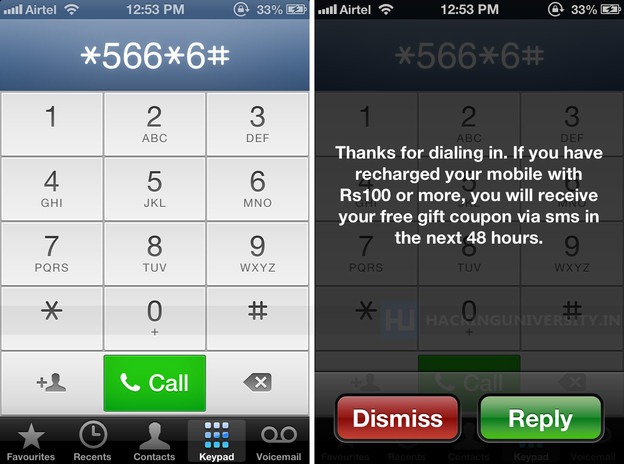
airtel-free-balance
  1. Well first you must own a Airtel Number as this trick works only for it.
  2. Now from your dial pad dial *566*6# and press call.
  3. Now you will receive a message from them like "Thanks for dialing in, If you have recharged your mobile with Rs. 100 or more, you will receive your free gift via sms in the next 48 hours."
  4. And that’s it now you just need to wait for 48 hours till you get an easy Rs. 100 recharge for free.
  5. Well this trick is working as reported by people, even I have tried it right today so I am also going to wait for 48 hours.
NOTE As mentioned in their response message, I think your phone should be recharged with Rs. 100 before you apply for this trick, I don’t know if it will work without that too but I will update this post as soon as I will receive the balance

How to Transfer Windows Files - Images - Settings Easily


Have you purchased a new PC or shifted to an old one but all the data stuff is in your previous PC, well than that’s not a big problem because we have Windows Easy Transfer official transfer tool by Microsoft well with this you transfer files, pictures, images and settings to any new windows operated pc The best thing about this tool is that it also includes a file explorer or you can say file manager which you see many times on a Nokia phone so you can also see what things to copy and what not.
windows-easy-transfer
This tool is official developed by Microsoft for their humble customers, giving them an easy way to complete the whole process. Check below steps on how to use this awesome simple tool.
  1. Download Windows Easy Transfer Tool.
  2. Now just run this tool on your old pc from which you are willing to transfer your files and settings. You can choose to backup settings in your external drive such as pen drives.
  3. Now just run this tool again on your new pc and choose the file from external drive to restore the whole process in your new pc.

Friday, 21 September 2012

The death of Firefox


It doesn’t look good for Firefox: Almost every month for the last three years, Firefox has lost ground to Internet Explorer, Chrome, and Safari. For most of 2009 the trend was fairly straight as it fended off Chrome and nibbled away at IE, but between 2010 and today Firefox has lost a third of its market share, from a worldwide peak of around 30% down to 20%.
You can look at this two ways. First, the total number of people on the internet is growing, so while Firefox’s share has decreased, the total number of people using Firefox is increasing. The other point of view is that Firefox, whether you like it or not, is declining in popularity.
I love the Fox as much as the next bearded geek, but the numbers just don’t lie: Chrome is breathlessly decimating Firefox’s userbase at a breakneck rate. It took Firefox more than four years to prise 20% of the market from Internet Explorer; Chrome did it in almost half that, and is fast approaching 30% in just over three years. Internet Explorer’s graph is a little harder to interpret, but it looks like it might have finally turned the corner and stopped hemorrhaging market share.
Firefox market share trend
Compounding Firefox’s losses is the stark reality that it’s unlikely to make any gains. Google has obviously spent a lot of money advertising Chrome, but there’s no way that ads brought it nearly 30% of the web’s two billion surfers. People are migrating to Chrome because of word of mouth: Geeks and power users picked it up first, and they’ve been installing it on the computers of friends and family ever since. Microsoft, too, is using a dollar bill tourniquet, and when Windows 8 tablets roll around with IE10 as the default browser, you can be sure that its market share will climb. Mozilla is adding some exciting new features toFirefox, and Firefox for Android is an interesting enterprise, but I don’t foresee anything that will turn the tide.
But is that really a problem? The entire reason that Firefox was such a success is that it appealed to the geeks and power users who weren’t happy with Internet Explorer 6′s 95% share of the market. Microsoft effectively put the dampers on web innovation for five years. Firefox was conceived with one purpose in mind: To revitalize the web.
In that regard, it has succeeded. The web, with three browsers vying for supremacy, has never been more exciting. Within a few short years of launching, Firefox had shown the world what CSS and a gutsy JavaScript engine were capable of. Firefox triggered the HTML5 revolution. It is because of Firefox that Metro-style Windows 8 apps can be written in JavaScript. And ironically enough, it is because of Firefox that Chrome was created.
If you used Chrome in 2008 and 9, you will remember that almost all of its early adopters were disaffected Firefox users who had grown tired of an ever-increasing memory footprint and sluggish interface. Chrome had almost zero features when it first arrived, but it didn’t matter: When the only two choices were a slow Internet Explorer or a bloated Firefox, Chrome was exactly what the people (and the internet!) needed. Mozilla has spent the last year trying to trim the fat, but it hasn’t caused an upswell of users to return to the motherland. Much in the same way that Firefox cannibalized Internet Explorer, Chrome capitalized on just a single feature — speed — and has been riding the wave ever since.
A sad and tired red panda (firefox)Despite its ridiculous rate of growth, though, Chrome will eventually reach a zenith. The Big Three all have enough gravitas to ensure that no one browser has the power to monopolizingly choke the web. Even if a browser does get a little too big for its britches, Mozilla will always be there to knock some sense into the community — and, if need be, do the grassroots thing all over again.
What will happen now, assuming Microsoft and Google continue to barrage each other with their full arsenal of cannon, is that Firefox will gradually fade into a position of feared, revered veterancy — kind of like an aging grandfather who sits on a rocking chair in the middle of the World Wide Web with a loaded shotgun. It might even get to the stage where Firefox has to occasionally loose some crazy feature onto the web, just to remind everyone that it’s still alive. Eventually, if Microsoft really is serious about open web technologies and Google does no evil, Firefox might even die.
But, having completed everything you set out to do in life, is death really that awful?

Air travel in 2050: Autonomous planes flying in geese-like formations


One day in the not-so-distant future, semi-autonomous airplanes will fly through the skies like flocks of geese, reducing drag and saving fuel. This concept is part of a broader plan by airplane maker Airbus to modernize the industry over the next three decades.
“Our engineers are continuously encouraged to think widely and come up with ‘disruptive’ ideas which will assist our industry in meeting the 2050 targets we have signed up to,” Airbus’ engineering chief Charles Champion says. “These and the other tough environmental targets will only be met by a combination of investment in smarter aircraft design and optimising the environment in which the aircraft operates.”
While planes presently fly with about 1,000 feet (300m) of vertical separation between them, computer-controlled planes could fly much closer. The planes’ flight control systems could also ingest weather and atmospheric conditions and adjust to constantly fly the best available route, while at the same time maintaining a safe distance from other nearby planes.
This all may sound like an attempt at removing the pilot from the flying process, but Airbus cautions that is not the case.
The pilot is still in control of the aircraft, but the enhanced computer system will act as a backup, smoothing out the natural pilot error. Flying in such close formation obviously requires precision, far more than even the most experienced pilot can provide. Accidents and issues do happen, so Airbus sees it as important for the pilot to still have control. The goal here is efficiency, and the company’s research shows that’s exactly what such a system provides.
On average, thanks to reduced air resistance — just like a flock of geese flying in a V formation — flights will be about 13 minutes shorter, and about 9 million tons of aircraft fuel will be saved. Billions of dollars a year will be saved in fuel costs, which hopefully would have the effect of making air travel cheaper too. There’s also an environmental benefit here: 28 million less tons of CO2 emissions would be put into our atmosphere each year.
Besides the more advanced computer systems in planes, Airbus has other concepts that it plans to test, and has set a goal of the year 2050 to deploy these technologies.
In addition to computer controlled flying, Airbus proposes a superfast ground vehicle to launch aircraft into the sky, and free glides into airports. In both cases, this would require much less runway, which means airports could be constructed in highly-populated areas where land comes at a premium. Another time and fuel saving measure is optimizing the taxiing of planes around the airport, by using robotic taxi vehicles powered on renewable energy.
Champion says that while Airbus is serious about making air travel more efficient and cost effective, his company will not be able to do it alone. “The future of sustainable aviation is the sum of many parts and success will require collaboration amongst all the parties who are passionate about ensuring a successful prospect for aviation,” he says.

Sony SLT-A99: Can Sony’s full-frame DSLR go head-to-head with Nikon and Canon?


Sony has been clawing its way towards the front of the pack when it comes to high-end cameras. It has made a large step forward with the introduction of the SLT-A99. While replacing the A900 as the full-frame camera in Sony’s lineup, the A99 is a radically different beast. At 24 megapixels and 6-8 fps, it is dramatically faster than the A900. It also omits the movable mirror and optical viewfinder found in DSLRs, moving to a full-time electronic viewfinder (EVF) and Sony’s SLT (Single Lens Translucent) technology.

Sony’s SLT, fixed-mirror approach

The Achilles heel of SLRs — both digital and film — has always been the heavy, moving mirror. It slows down the camera, increases costs, and decreases reliability. However, it has also been the signature feature of SLRs, allowing the photographer to get a clear, optical view of exactly what is in front of the lens. Sony’s SLT technology is designed to provide the best of both a DSLR and a mirrorless camera.
SLT models use a semi-transparent fixed mirror. About 80% of the light let in by the lens is transmitted directly to the sensor, while about 20% is siphoned off for use by the EVF. Sony has eliminated the need for a separate light path for the AF system by building phase detection AF into the sensor chip itself. This type of hybrid design is one of the major advantages of CMOS sensor technology over CCD — which requires dedicated sensors.

Technical details of the A99

Sony's SLT-A99 features a tilt-swivel LCD and an EVF instead of an optical viewfinderOverall the A99 has very competitive specs, as you’d expect from Sony. It features a 24MP full-frame sensor — with integrated phase detection AF that allows it to shoot at up to 6 fps while focusing. When cropping to APS-C the A99 shoots at up to 8 fps. The A99 also features built-in GPS, a welcome addition in a DSLR. 14-bit Raw mode and ISOs up to 25,600 help round out the pro-caliber image features.
Borrowing from a popular point and shoot design, the A99 offers a tilt and swivel LCD, although retaining the traditional top LCD for the display of key camera settings. For video purists willing to spring for a separate video recorder, the A99 also offers uncompressed HDMI output.
One novel feature of the A99 is a six-shot noise reduction mode. The camera takes six frames and combines them to minimize noise in the resulting image. Sony claims this adds an effective two stops of ISO sensitivity, but presumably it requires a stable subject and camera to work well.
Since SLT cameras rely entirely on their EVF, Sony has worked to provide a state-of-the-art version on the A99. The Tru-Finder OLED version has a 2.4 million pixel display and provides a realtime look at camera adjustments. Like many newer models, the A99 features dual memory card slots. Both can take SD cards, while one can double as a Memory Stick slot.
Positioning it as a pro-level camera, Sony has added dust and moisture protection to the A99, a key feature for anyone making a living with their camera. Its shutter is also rated at a hefty 200,000 shots. Other features like a sweep panorama mode seem more suited for what Sony calls advanced amateurs — since most pros will want to set up their panoramas more carefully — but will certainly be handy in a pinch.

XQD: Is it DOA?

When Nikon helped launch Sony’s XQD digital film format with the Nikon D4, the new cards were billed as the successor to CF cards for high-end cameras. Now Sony has launched its new flagship full-frame camera, a $2800 beast, and is relying on much less expensive traditional SD cards — including the newest SDXC version — to make it go.
If Sony believes SD is good enough for a 10 fps burst-mode (when using tele-zoom) camera that can shoot 1080p video, it’s hard to see a real market for XQD as a card format. I loved the speed of XQD combined with a USB 3.0 reader when I wrote about my experiences with the Nikon D4, but if it hadn’t been a review unit the card and adapter would have set me back over $300.

Can Sony sell a $2800 camera?

According to Sony the SLT-A99 is the world's lightest 35mm full-frame interchangeable lens camera, at 740 grams -- because of its SLT tech and magnesium alloy panels.Sony’s SLT technology is clearly ground-breaking, and when included in the $699 SLT-A57 it raised the bar for entry-level DSLRs. The SLT-A99, however, when it goes on sale in October, will be priced at a much heftier $2800 — nearly the same price as the industry-leading Nikon D800e and the Canon 5D Mark III. Both Nikon and Canon have better brand recognition among photographers and a much larger array of lenses and accessories — making the battle an uphill one for Sony. Just as Sony has worked its way back into the full-frame market, Nikon has upset the apple cart with its introduction of the Nikon D600. At 24MP, 5.5 fps, and a retail price of $2100 — $700 less than the Sony — Nikon may have stolen Sony’s thunder before the A99 is even in the market. The Nikon model is set to ship next week.
Sony does have one huge ace up its sleeve, though — speed. Because of its fixed-mirror design, the A99 is much faster than the similarly priced Nikon, and goes toe-to-toe with Canon. It’s tempting to jump to the top and compare the Sony with Nikon and Canon’s flagship models. However, because of the SLT design not all of the light let in by the lens reaches the camera’s sensor. As a result, it’s unlikely that the A99 will be able to compare with the Nikon D4 or the Canon 1D X, both of which combine large sensors and large pixels for industry-leading low-light performance.